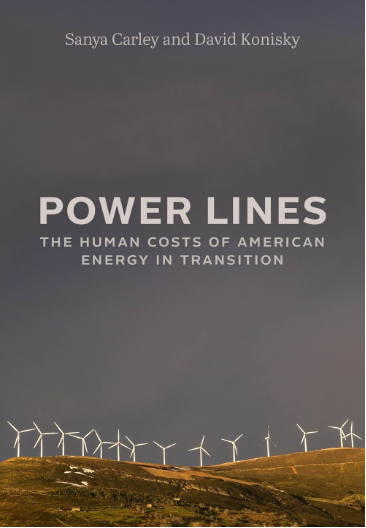
Power Lines

Editorial Reviews

Power Lines is an enjoyable exploration of the trade-offs and complexities in both maintaining our current electricity generation and delivery system while also evolving it into what many analyses believe is a necessary 'Just Energy Transition' to meet the power, political, and environmental challenges that we face today.” -- Daniel Kammen | University of California, Berkeley

Energy transition continues to generate winners and losers among American families and communities. 
Power Lines renders an invaluable public service through its penetrating examination of this dynamic. It navigates multiple regions and technologies involved in energy production and use in exploring challenges to achieving just outcomes.” -- Barry Rabe | University of Michigan

This book transmits a surge of reality by grounding readers in the complexity faced by our society to orchestrate an equitable energy transition that benefits 
all people. The authors weave facts with frankness; build a case for prosperity by centering people; and elevate the stories of overburdened communities striving for the energy security they deserve. A great source of information, leaving readers charged up to demand environmental and energy justice by any means necessary.” -- Dr. Jalonne L. White-Newsome | CEO and Founder of Empowering a Green Environment and Economy, LLC | former Federal Chief Environmental Justice Officer in the Biden-Harris Administration

"In an era when far too many of us advocate simplistic 'solutions' and technofixes to address the climate and energy crises, Carley and Konisky offer a hard-hitting, much-needed dose of truth telling that centers people, equity and justice in how we imagine and realize decarbonized futures. The evidence, analysis and conclusions in 
Power Lines are exceptionally strong and will stand the test of time." -- David N. Pellow | author of "What is Critical Environmental Justice?"

Associated Press

Environmental Politics

The U.S. energy transition represents a fundamental restructuring of power relations that will either entrench or ameliorate existing inequalities. This is the sobering premise of Carley and Konisky’s Power Lines, a comprehensive review of how the shift from fossil fuels to renewable energy will create winners and losers across American society...The book’s most compelling contribution lies in its focus on human experience across the energy lifecycle...The authors’ documentation of energy insecurity or energy poverty – affecting one in four American households, with African American households three times more likely to face disconnection (p.3) – transforms abstract policy debates into urgent moral imperatives. 

Motsick, Jason R. 2026. Power lines: the human costs of american energy in transition. Environmental Politics
Link here

Environmental Research Energy

Power Lines: The Human Costs of American Energy in Transition by Sanya Carley and David Konisky is a timely contribution to energy justice and energy transition scholarship. Drawing on their many years of research, Carley and Konisky present the complexities of an energy transition away from fossil fuels. As Carley and Konisky argue, there is no guarantee that transitioning to renewable energy will free underserved communities from living near energy production facilities nor is there any guarantee that these communities will receive the benefits of an energy transition...There is no doubt that an energy transition is necessary to stop the worst impacts of the climate crisis, but as Carley and Konisky argue, there are difficult tradeoffs that must be understood and addressed.

Cha, J. Mijin. 2026. Book Review: Power lines: the human costs of American energy in transition by Sanya Carley and David Konisky. Environmental Research Energy. 3. 010201. 
Link here.