

Duke Energy has asked North Carolina regulators to approve major rate hikes for both of its North Carolina utilities while also increasing the “return on equity” that the utilities may earn. Return on equity (ROE) is the profit that the utilities are allowed to earn on the equity-financed share of their capital investments; it drives utility profitability.
In November, the Charlotte-based company, which earned $4.4 billion in net profits last year, filed a request with the state Utilities Commission to take an additional $1.7 billion in revenue over two years: $1 billion from its Duke Energy Carolinas customers, a 15% increase over current levels, and $729 million from its Duke Energy Progress customers, a 15.1% jump. The new rates would take effect in 2027.
For residential customers, the increases would be substantial. If the North Carolina Utilities Commission approves the request, monthly electric bills for typical Duke Energy Carolinas residential customers using 1,000 kilowatt-hours would climb by $17.22, from $144.98 to $162.20, followed by another $6.34 increase the following year to $168.54. Monthly bills for typical Duke Energy Progress residential customers using that same amount of electricity would increase $23.11, from $163.84 to $186.95, and an additional $6.59 jump a year later to $193.54. Commercial and industrial customers would see smaller increases, ranging from 3.4 to 9.2%.
...
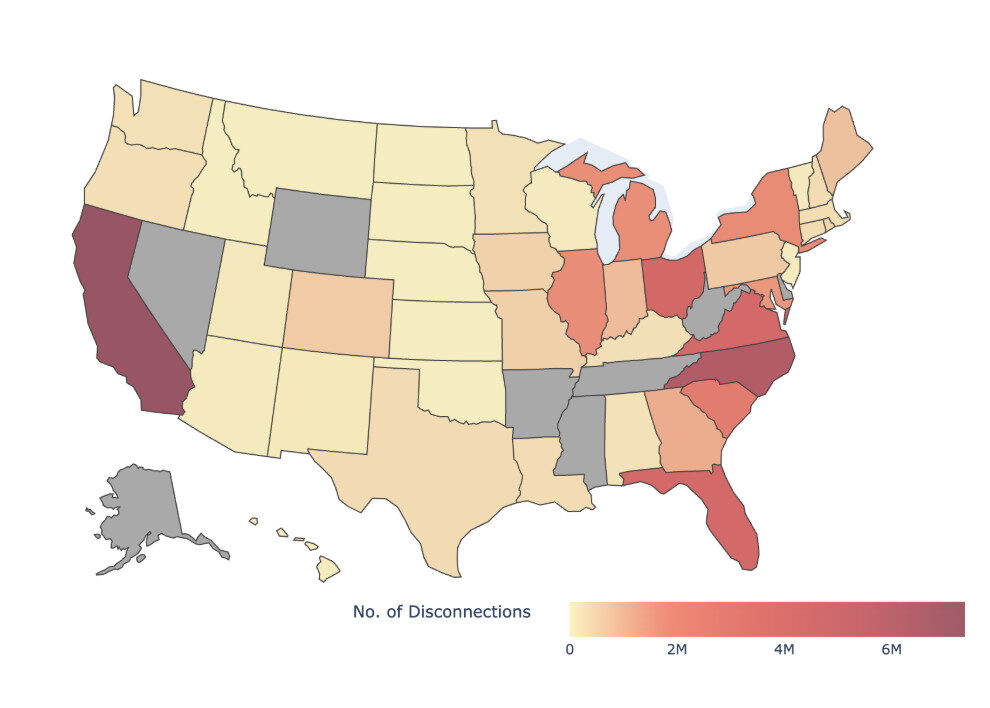
Between 2019 and 2024, North Carolina had the second-highest number of utility disconnections among the 42 states that report this data, surpassed only by California, according to the Energy Justice Lab’s Utilities Disconnection Dashboard, compiled by Sanya Carley and David Konisky. In that period, North Carolina utilities made a total of 6,756,140 disconnections. Duke Energy Carolinas made the most, followed by Duke Energy Progress.
Multiple studies have tied electricity shutoffs and energy insecurity more broadly to respiratory illness, cardiovascular disease, mental health problems such as depression and anxiety, and greater difficulty managing chronic conditions like diabetes.